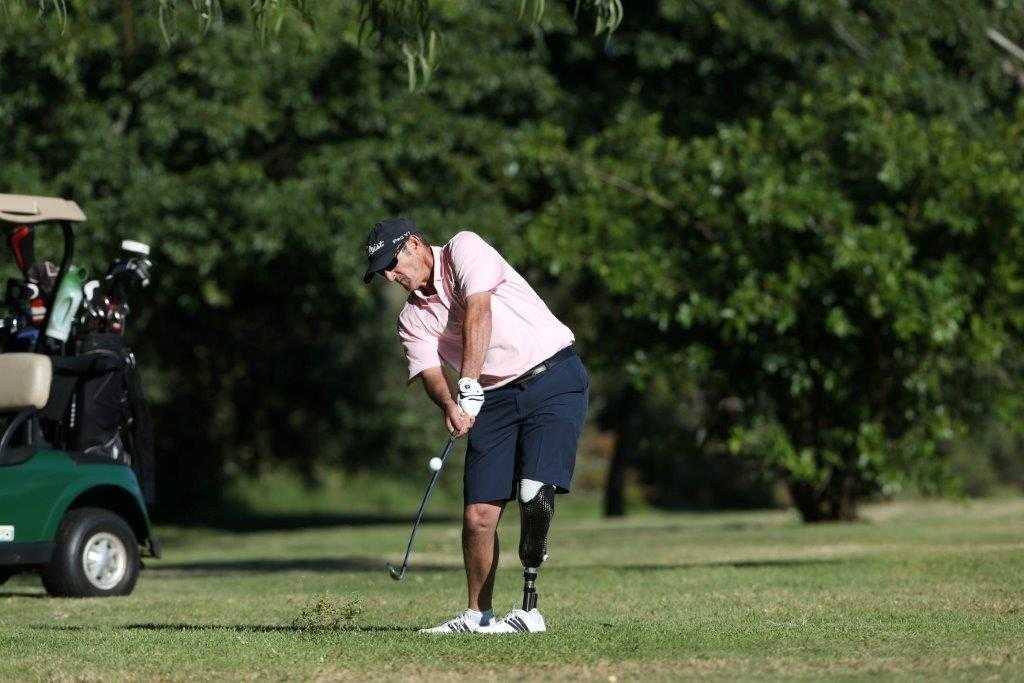
For disabled people, the world can be a cold and lonely place. Cocked heads and double-takes from those for whom the chips of life fell favourably, are almost a daily occurrence. Deep within this seemingly uninviting society, however, lie hidden gems. Places where disabilities and uniqueness are revered rather than ridiculed. One such place is the South African Disabled Golf Association.
After being forced to hang up my cricket whites at the age of 13 due to poor eyesight and reflexes, I turned to golf. My hope was that by playing a stationery ball instead of a moving one, I had found a game to assuage my hunger for sport and competition. While the former proved true from the outset, the latter did not. It became abundantly clear that golf with my friends was anything but a level playing field ─ my mates would outdrive me by 30 metres with nauseating regularity. While they cruised onto Par 4s in regulation, I battled to get up in three. Hardly ideal ingredients for a tight contest.
It then dawned on me that the solution was right under my nose ── or a short walk from the practice putting green at my home course, King David Mowbray. I expressed interest in joining SADGA to Operations manager Lily Reich and, after undergoing physical tests to verify the extent of my disability, I officially became a member of the South African Disabled Golf Association.
Above: Outside the South African Disabled Golf Association office at King David Mowbray Golf Club. Credit: Craig Stirton.
SADGA brings together people from all walks of life and abilities as a golfer. After playing in a handful of Provincial Days, I came to appreciate just how inclusive the environment is. Everyone is extremely approachable and happy to chat about their life stories and how they lost their leg, why they walk with a limp etc. Whether you’re in it for the camaraderie and the friendship or have designs on victory, there is a place for you. One need look no further than this year’s SA Disabled Open to know that there is some serious talent within disabled golf ranks. Mike Browne of England, who is a leg amputee, shot an impressive 54-hole score of 232 to scorch to a 12-stroke victory at Magalies Park. Needless to say that off a 27-handicap I’m better off playing for the camaraderie and enjoyment! I now certainly understand the meaning behind SADGA’s motto that it’s not about people with disabilities but rather about “being a golfer”. In a recent interview with Lily, I learnt that “most of the guys don’t actually think they’re disabled”.
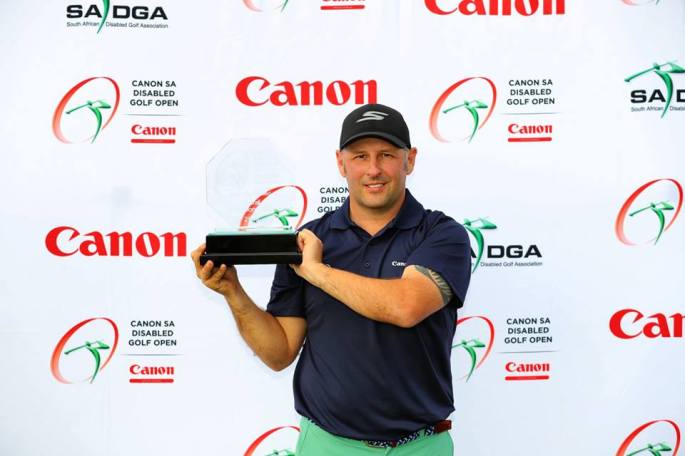
Above: Mike Browne of England poses with SA Disabled Open Trophy. Credit: South African Disabled Golf Association.
Yet the good work that SADGA does, extends beyond just providing an environment in which its members can feel comfortable in their own skin and compete on a level-playing field. The formation of the First Swing Programme in 2008 has enabled SADGA to not only give disabled children a start in golf, but also positively impact their lives in future. Though initial growth was somewhat painstaking, there were only 90 registered participants by 2013, the Programme has enjoyed exponential growth in subsequent years and now boasts more than 1000 participants. SADGA’s team of 20 coaches oversee the running of the first three levels of the five-tier programme which is aimed at severely disabled golfers from underprivileged backgrounds.
The use of SNAG equipment allows the coaches to set-up modified golf environments in the school halls. The drills incorporate a number of different muscle groups. Thus everything they do “has a purpose”. Once the children attain a certain level of competency they graduate to Level 4 where they receive an official handicap. For those players who eventually attain a single-figure handicap, the doors to becoming PGA-accredited coaches opens up for them.
“I’m not going to be around forever and in five or six years’ time, they must run the programme. They are the perfect people and the perfect representatives and ambassadors to stand up there and talk on behalf of disabled golf.”
That SADGA counts South African Golf legends Dale Hayes and Retief Goosen amongst its ambassadors is a testament to the immense impact that the organisation has had since its inception in 2004. Reich is grateful for the pair’s involvement and says it has been fantastic that the junior members have good role models to look up to.
“Retief Goosen actually sponsored a hole here at the SA Open and sent us a nice dollar-cheque. Dale is very passionate and Zwartkops is our home of disabled golf in Gauteng so most of our golfers actually belong to Zwartkops which is incredible. He’s very good to us and gives us exceptionally good rates as well so we love him,” she says.
It is the commitment to breaking down barriers between able and disabled people that is most commendable about SADGA, though. After years of hosting provincial days and SA Opens across the country, Reich began to notice how the caddies “were too scared to go near the guys, clean their clubs or do anything”. This prompted the decision to host an all-abilities caddies clinic ahead of this year’s SA Open. Caddies were taught how to caddie for a disabled person. An integral part of this process is allowing the caddies to play a hole in a disabled golfer’s shoes so to speak. The caddies would play one hole blindfolded, another on one leg etc.
“In this way, you get an idea of what it’s like to have a disability before you caddy for a disabled person,” commented Reich.
Many a shifty look has been shot my way as I limp down the fairways of King David Mowbray. At a SADGA Provincial Day, however, I am often the most “normal” in a four-ball of arm and leg amputees. But this matters not ── after all… it’s about being a golfer.
Photo: South African Disabled Golf Association
WATCH: A chat with one of SADGA’s many success-stories, Ignation Douries.
 Free Drop Media