
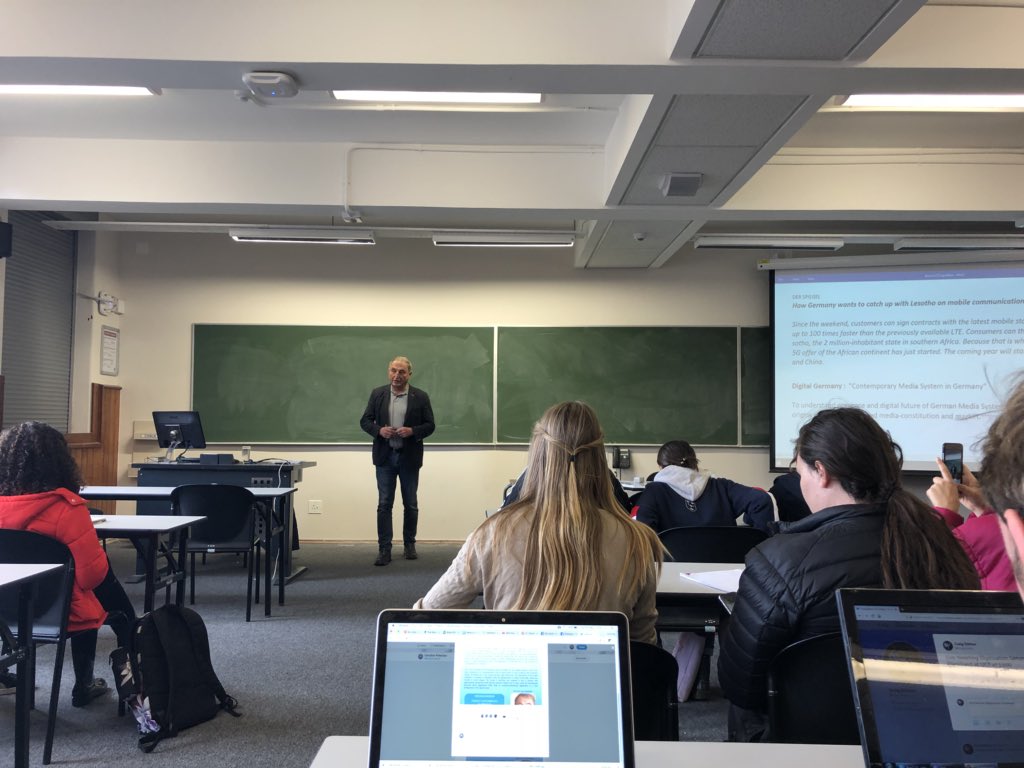
Professor Dr Jens Wendland believes that the sands of time are running out in the age of print journalism. In a lecture given at the University of Cape Town on Tuesday, Wendland predicted that print newspapers may cease to exist in thirty years time. Craig Stirton reports.
Wendland explained that in order to understand the present-day media structure in Germany, it is necessary to understand the past. To this end, he described the Public Broadcast monopoly that was in place in Germany in the aftermath of World War 2.
“Germany had no free newspapers and radio because of the NS regime. The new broadcasting system after the second World War there was the start of a Broadcast public monopoly. The new broadcasting regime after the second World War was imported by the BBC for German radio and tv”, Wendland explained.
As media became digitised in the 1980s through the advent of cable tv and satelites, so distribution channels became unlimited. On the one-hand, digitisation of the media has allowed countries that had no pre-existing traditional systems in place to move with the times and innovate. By contrast, Germany is being dragged kicking and screaming into the future.
The problem in Germany according to Wendland is that middle-class entrepreneurs are struggling to innovate in the age of digitisation. Moreover, the German media would rather cater for an aging population than gravitate towards digitisation.
“The demographic situation in Germany is very important. The German population is getting older and older and that’s got consequences for media usage and media production. In Germany in the main Programmes, you have features, fiction and series for older people.”
A number of factors are conspiring against the future of Print newspapers. For example, The advent of streaming services is posing a threat too. 2013 saw the same number of people use radio as used the Internet. According to Comscore, of the 81 million people living in Germany, 55-Million people spent at least 24 hours a month on the Internet.
The need for adaption is becoming more pressing with time. The issue for print newspapers is that revenue avenues are beginning to close. Newspapers rely on advertising and retail revenue to remain afloat. In recent times, however, advertising has moved out of print and onto the Internet. For this reason, Wendland is of the opinion that the next generation of media producers may do away with archaic media systems.
Make no mistake, more current forms of media are not necessarily better. Wendland believes that society would lose a lot if print media was to be discontinued.
“I think you lose the view of the fence. Newspapers are an integrative instrument for showing the views and perspectives of society. If you separate it, you lose a moment of integrative moment of communication within society.”
Another red-flag to the future of print newspapers is the outsourcing of editorial work. It thus comes as little surprise that Wendland remarked that prominent newspapers have begun losing money had over fist. The up-shot of this is that many newspapers are being shut down.
The age of digitisation is well underway. There is certainly the sense that in media it is out with the old and in with the new. Whether it is for the best is still up for debate.
Photo: @Caroline_journo/Twitter
 Free Drop Media