
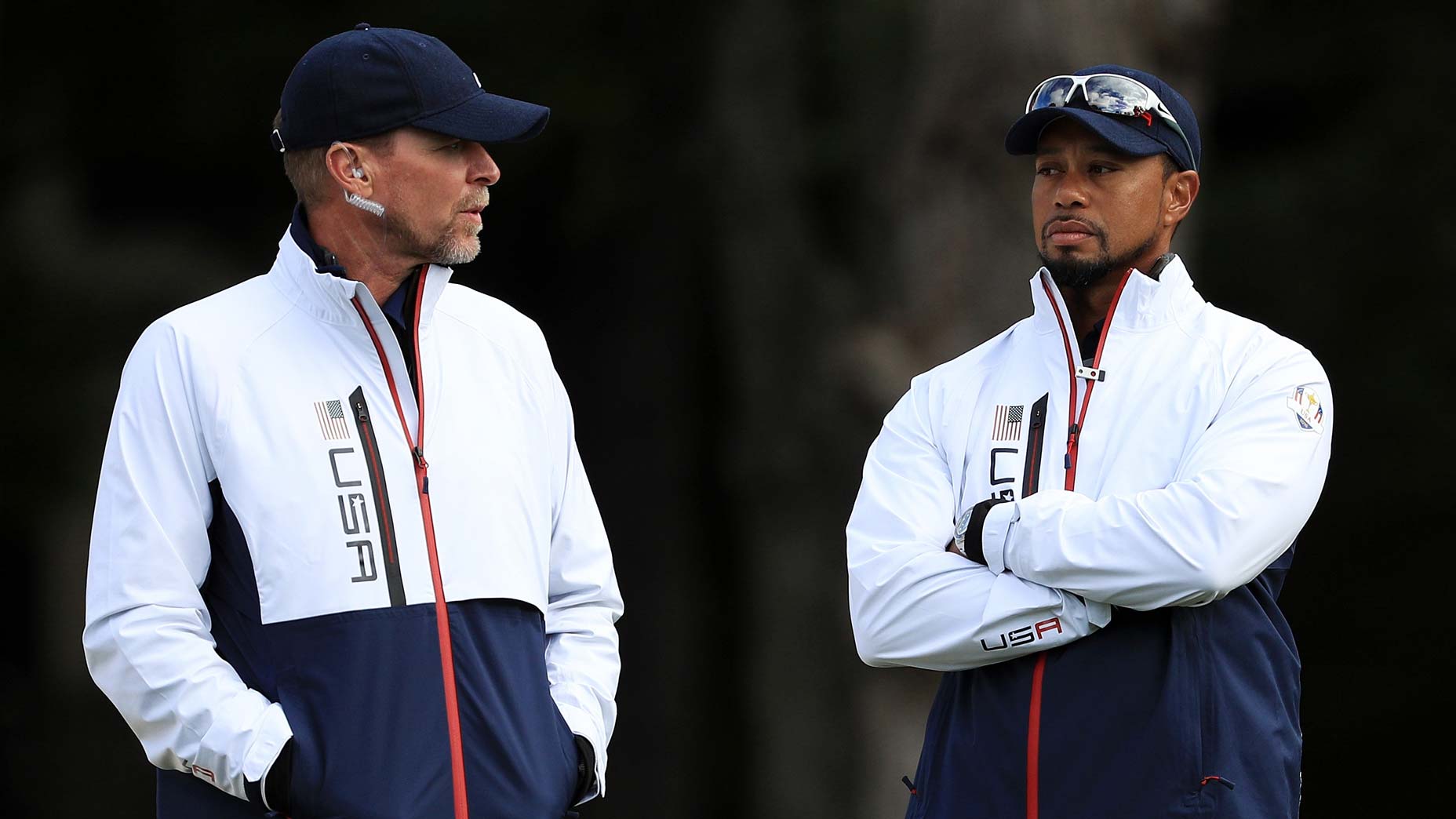
United States captain Steve Stricker will have his work cut out to create a team chemistry conducive to winning back the Ryder Cup, writes Craig Stirton.
Two years is a long time to wait to revel in one of the best events in sport. Three – due to the Covid-19 pandemic – may have installed the upcoming edition at Whistling Straits as the most anticipated Ryder Cup in recent memory.
From a personal standpoint my interest is two-fold. On the one hand I am positively pumped to see whether Europe can once again engineer a victory away from home.
On the other hand, I’m fascinated to see whether the Americans can successfully overcome a potentially troublesome team dynamic.
Let’s start with the most glaring issue in recent memory – Brooks Koepka and Bryson DeChambeau. The war of words which has raged between the two since the start of 2020 has captivated golf media and fans alike. What intrigues me about the whole thing is that for the life of me I can’t figure out whether it’s all in good humour or if they have a genuine and deep-running dislike for each other.
Koepka condoning fans’ behaviour who heckled DeChambeau at the Memorial Tournament by shouting “Brooksy” after he (DeChambeau) played shots would seem to suggest that from Koepka’s perspective Bryson isn’t a friend he’s merely poking a little fun at.
While it’s all well and good for the pair to exchange barbs on social media for the time being, the Ryder Cup is fast approaching and Stricker ought to try to resolve the apparent animosity before the week gets underway.
That’s not to say that the Ryder Cup hinges on the pair’s willingness to patch things up but for the better part of two decades the Europeans have not only managed to outplay their American counterparts but they’ve enjoyed sustained success due to a wonderful team spirit.
That for me has been the difference certainly since I started watching the event in 2010. What the Europeans may lack in depth on paper – they make up for considerably in their determination to leave it all out there as much for their playing partner as for their country and continent.
Perhaps that’s been the one shortcoming of the USA’s much-vaunted Task Force. Established after the disaster at Gleneagles in 2014 in an effort to arrest the slide they’d suffered – it is my understanding that the Task Force aimed to establish a sound captaincy selection process whilst also creating greater structure in the planning process leading up to events.
To their credit – the Task Force yielded immediate results with a 17-11 blow-out at Hazeltine. In the same breath, however, the United States team was hammered 17.5-10.5 at Le Golf National in 2018. But that’s besides the point – while the Task Force may have aided preparations and the data-gathering process, it certainly isn’t guaranteed to breed team unity and camaraderie.
But the issues the Americans face from a team chemistry standpoint go beyond just Bryson and Brooks. It goes without saying that the polarising Patrick Reed is a captain’s nightmare from a team-room and pairings standpoint.
Remember the fuss he kicked up when Jordan Spieth – with whom he’d had success in the past- wanted to instead play alongside Justin Thomas? That’s to say nothing of the rules controversies which have dogged Reed in the ensuing period and the effect these have had on how he’s perceived by potential teammates.
The United States selection criteria looks slightly different this year with six automatic qualifiers and six captain’s picks.
At the moment Reed is in seventh on the standings and it’ll be interesting to see whether Stricker and his vice-captains deem the former Masters champion worthy of a pick. Cast your mind back to 2016 when Bubba Watson – another polarising figure – was overlooked by Davis Love in favour of lower-ranked players who may have been better team team players.
Lest we forget another big storyline from the 2018 Ryder Cup – the alleged scuffle between Koepka and Dustin Johnson following the conclusion of the event. With a host of rookies likely to make their debuts such as Patrick Cantlay, Xander Schauffele and Collin Morikawa to name a few, Stricker needs to make sure that his more senior players are in a position to lead from the front.
It’s clear, therefore, that while the Americans may possess greater depth (all six of their current automatic qualifiers are top-10 players in the world) – chemistry could be the key hurdle they’ll need to overcome to win back the cup.
Photo: Getty Images
 Free Drop Media